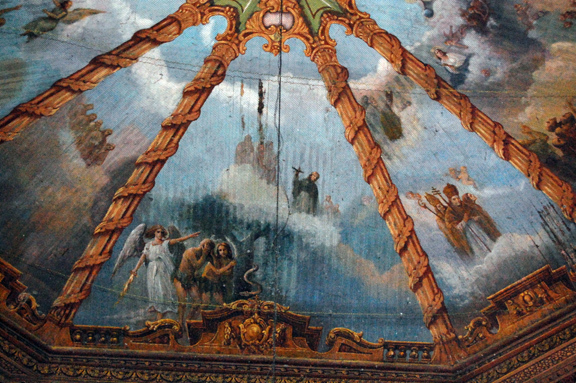
The tourist season is starting to gear up for the summer here in the Olongapo Subic Bay area. We have not reached a full frenzy so we took a day last week to explore a possible new tour. We been wanting to add a tour of churches and we contacted the CDC Tourism to take a look at what they had to offer. They offer a tour to seven churches that were built between 1572 and 1900. The churches that we visited were all very interesting but a few really stand out. We are still working on our own tour offering but we have already decided that a few are mandatory for our tour package.
 Betis St. James Parish Church located in Guagua, Pampanga, Philippines is one of the most impressive churches I have seen. It is written that Art enthusiasts compare it to the Sistine Chapel, for its magnificent interior, although the Betis Church is also impressive in terms of symmetry, gracefulness and theme. Fr. Fernando Pinto started its construction in 1660 and was finally completed in 1770 by Fr. Jose de Cruz. The National Commission for Culture and the Arts (NCCA) declared this church a National Treasure, one of only 10 churches in the country bestowed that honor.
Behind the alter is a magnificent retablo. A retablo or altarpiece is a shelf or wall 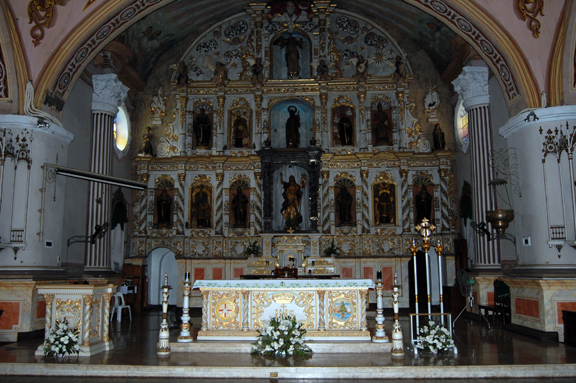
raised above the back of an altar to support ornaments, pictures, and statues from sacred history. It often has paintings or sculptures sometimes both. Spanish retablos of the Late Middle Ages and Renaissance grew extremely large and elaborate, typically using carved and gilded wood, and rising as high as 40 feet or more. This is the style found here. A side note for those who may not know about the area, Betis is now a part of Guagua but originally was a separate town. Betis is also well known both domestically and internationally for its carved wood furniture and religious statues. Legend has it that the art of wood carvings was introduced to the locals by Chinese artisans brought to the area to build the first church. The locals first mimic the styles of the Chinese and later over time develop their own styles. Given these fact should give you an indication of the splendor of the retablo.